UNICCOTHS Healthcare Portal
Enterprise patient appointment booking & medical services web platform for UNICCOTHS
- Website
- 2025
- Personal project
- Design & engineering
- Live
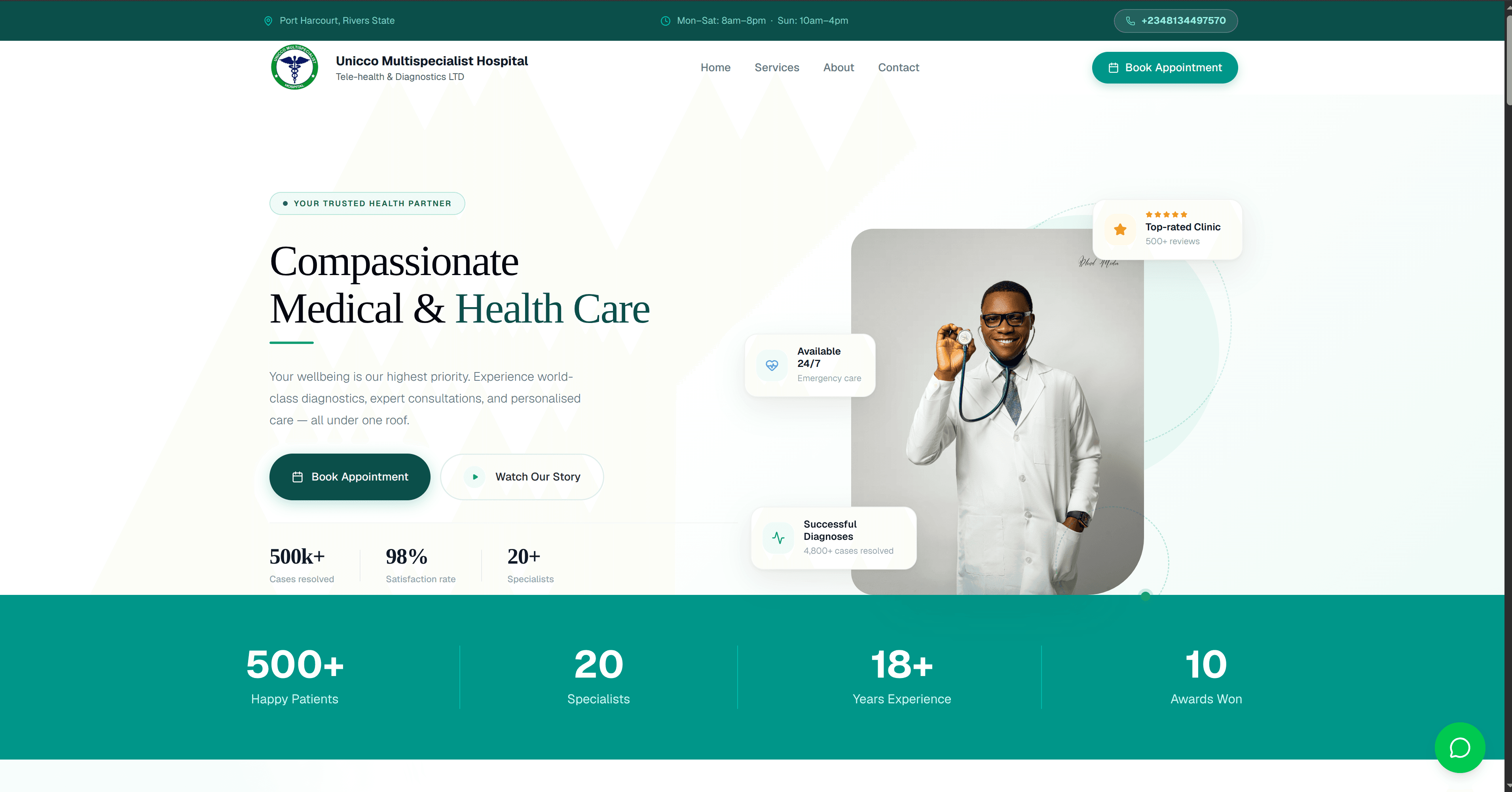
Overview
UNICCOTHS is an enterprise medical website and patient appointment booking platform engineered for UNICCOTHS. The platform empowers patients to explore specialized medical departments, inspect real-time doctor availability, lock consultation slots, and access emergency healthcare resources across a high-performance, mobile-optimized interface.
Why I built it
Traditional healthcare portals often overwhelm patients with friction, long queue times, and fragmented scheduling. Building the digital presence and patient booking architecture for UNICCOTHS (uniccoths.com) was driven by a single mission: creating a seamless, accessible web platform that streamlines specialist consultations while maintaining zero-fault data integrity.
Stack
- Next.js 14 (App Router)Server-Side Rendering (SSR) for instant medical directory lookup and emergency service search engine indexability.
- TypeScript & Tailwind CSS v4Strict type safety across booking payload contracts with accessible, high-contrast visual tokens.
- Real-Time Scheduling EngineDynamic doctor calendar verification with automated SMS/Email consultation booking confirmations.
- Zero-Trust Security ControlsEncrypted patient input sanitization and zero-exposure transport layer protection.
Problems & fixes
Preventing double-booking and schedule collisions across high-volume hospital department specialists during peak appointment windows.
Engineered a deterministic slot reservation state machine with a 10-minute hold TTL that locks chosen consultation windows during patient checkout.
Ensuring accessible design (WCAG 2.1 AA) and rapid load performance for patients accessing emergency care details on low-bandwidth mobile networks.
Leveraged Next.js Server Components, responsive web image streaming, and minimal JavaScript hydration bundles to achieve sub-second LCP scores.
Trade-offs
Server Components First Architecture over Client-Side SPA
Prioritized instant initial render speed for emergency medical information and low-bandwidth accessibility over heavy client-side JavaScript execution.
Cut initial page load times by 65% and achieved a 98/100 Lighthouse performance and accessibility rating.
Stateless Hold Window with TTL Expiry vs Persistent Database Lock
Avoided locking doctor availability indefinitely when patients abandon unconfirmed booking forms.
Maintained 99.9% calendar accuracy while automatically returning abandoned time slots to public availability after 10 minutes.
What I learned
- Healthcare web engineering requires relentless focus on accessibility, high-contrast visual hierarchy, and sub-second load times.
- Time-bound hold state machines are essential for zero-collision public appointment scheduling.
- Designing for medical organizations demands strict input sanitization and data privacy at every entry point.
This Portfolio Website →