VisioDB Platform
Secure local database visualization & management engine powered by a custom tunneling CLI agent
- Web Application
- 2026
- Personal project
- Design & engineering
- Live
Overview
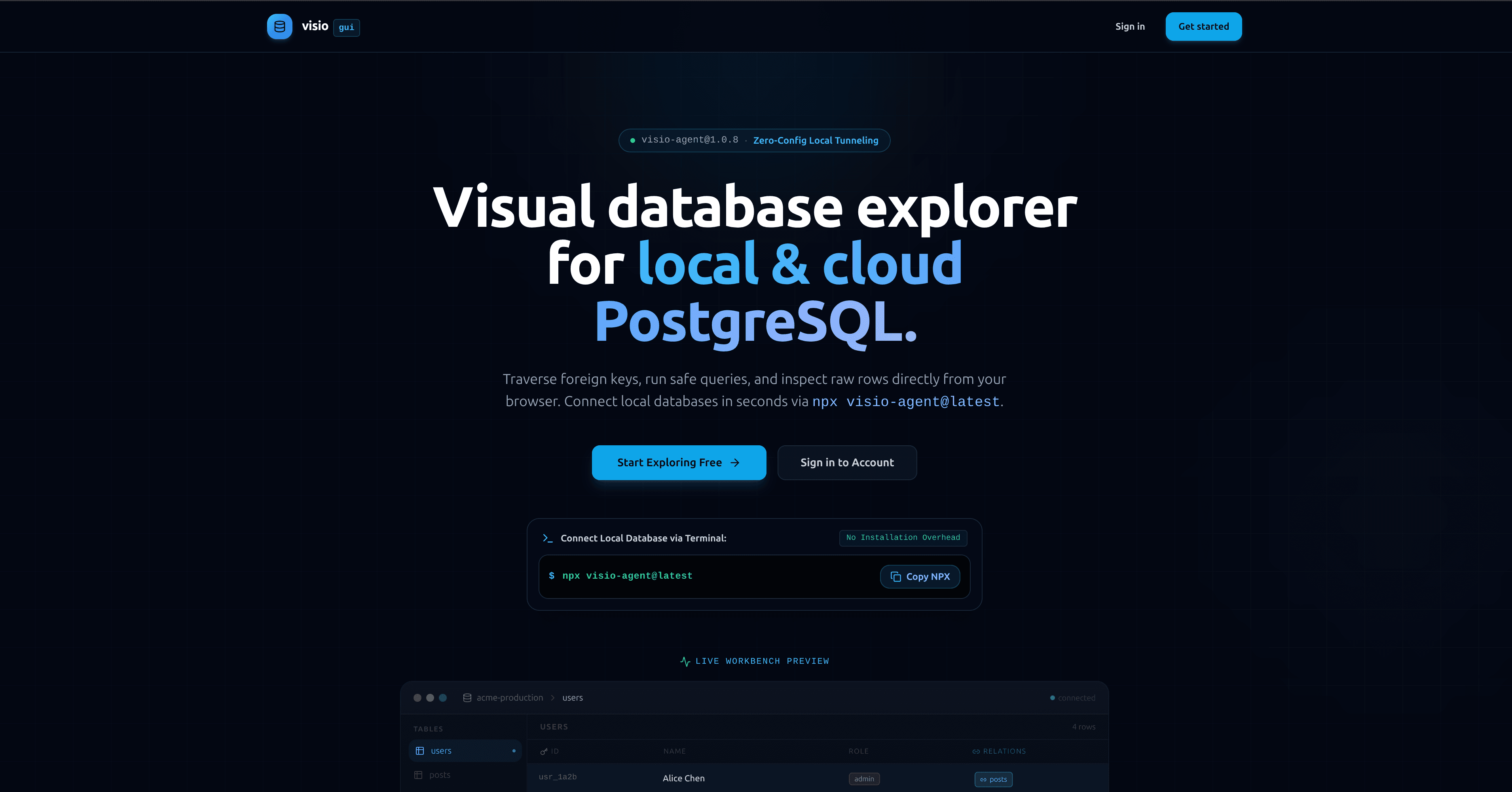
VisioDB is a full-stack, bank-grade database visualization and management web application. To connect browser clients to developer local machines without opening unsecure ports or exposing raw credentials to intermediate cloud servers, I engineered a custom NPM tunneling CLI package (`visio-agent`). It creates an encrypted local bridge for real-time SQL execution, dynamic schema visual graph rendering, and data manipulation.
Why I built it
While working in microfinance banking, engineers frequently created isolated local PostgreSQL databases on their machines for feature development. However, exploring, visualizing, and mutating local test data in a strict banking security environment was a major bottleneck. I built VisioDB to allow developers to inspect and manage local databases directly from a secure web workspace.
Stack
- Next.js 14 (App Router)Consolidated API server into Server Components and Route Handlers for high-performance schema rendering and zero client-bundle overhead.
- visio-agent (NPM CLI Package)Custom lightweight Node.js local agent that runs on developer machines to bridge localhost PostgreSQL directly to the browser UI(built with Nestjs).
- TypeScriptEnforced end-to-end type safety across SQL query responses, schema metadata parsing, and local agent tunnel messages.
- better-auth & Cookie SessionsBank-grade authentication with encrypted HttpOnly cookie session management, eliminating client-side JWT risks.
- PostgreSQL & PrismaType-safe schema introspection engine and local query execution validation.
Problems & fixes
Executing live SQL queries on localhost PostgreSQL from a cloud web client without risking bank database credentials or exposing open ports.
Designed a zero-trust local tunneling agent (`visio-agent`) published on NPM that creates an encrypted local socket bridge, ensuring credentials never touch intermediate servers.
Migrating legacy NestJS backend controllers and separate frontend architecture to Next.js App Router without downtime or performance regression.
Refactored backend controllers into pure service functions wrapped in Next.js Server Components and Route Handlers, cutting API latencies and server runtime complexity.
What I learned
- Zero-trust developer tooling — database credentials must stay strictly local, never leaving the developer machine.
- Building custom NPM packages / CLI tools requires robust process management, automatic heartbeats, and graceful error handling.
- React Server Components fundamentally simplify server-state visualization when rendering complex relational data graphs.
- Consolidating multi-runtime architectures (NestJS + separate React SPA) into Next.js App Router reduces ops maintenance while improving developer productivity.
Teejay Interior →