PostPilot Studio
Enterprise AI social media automation platform with Go backend & transactional outbox publisher
- Web Application
- 2026
- Personal project
- Design & engineering
- Live
Overview
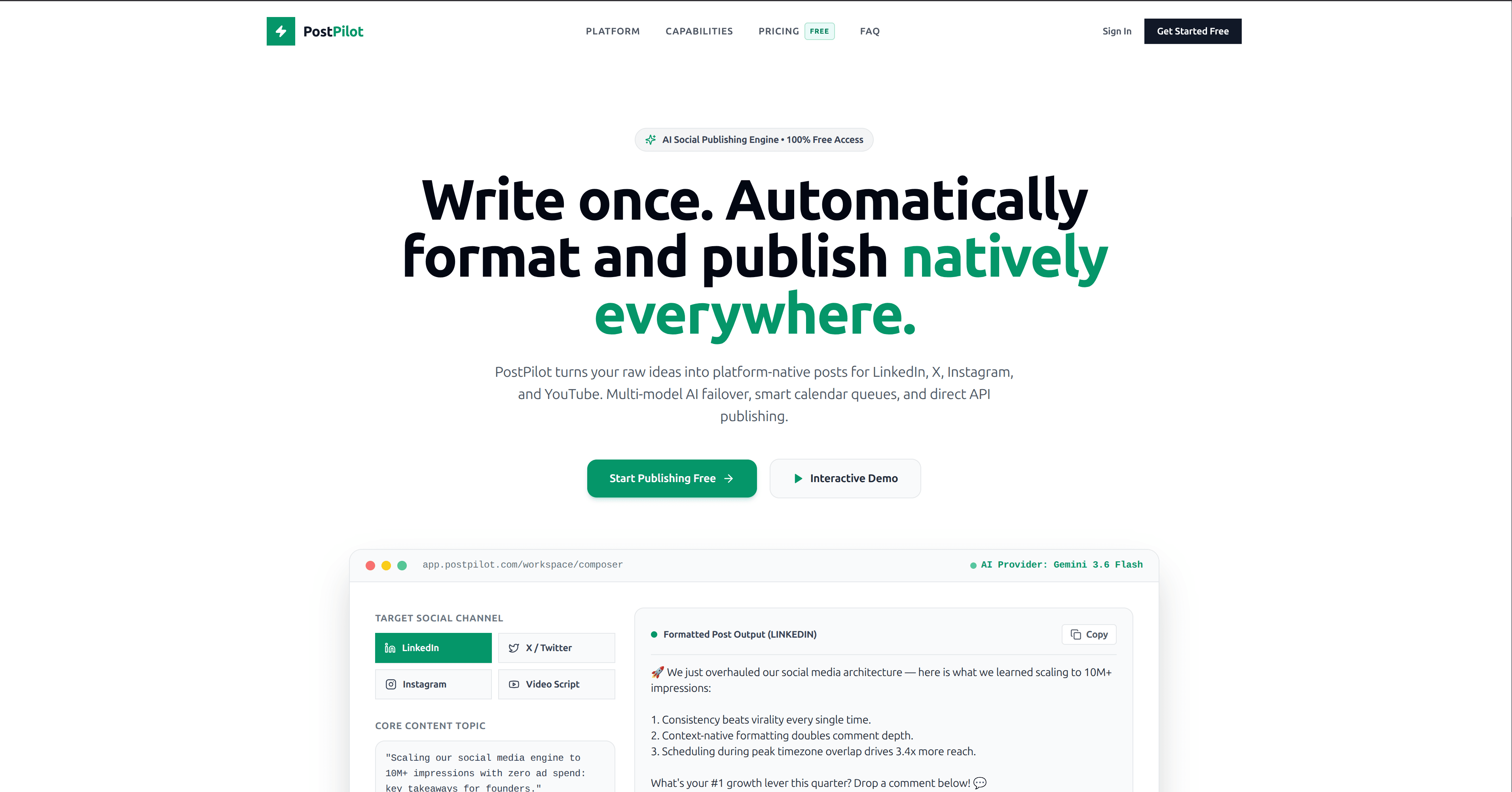
PostPilot is an enterprise-grade social media automation platform featuring a multi-provider AI content strategist (Gemini 3.6 Flash, GPT-4o, Claude, Groq), a real-time multi-platform preview canvas (LinkedIn, X/Twitter, Instagram, Video Script), and an event-driven background publisher powered by Go, PostgreSQL 16, and Redis Asynq.
Why I built it
Creators and marketing teams lose hours manually formatting and scheduling content across social networks, while existing tools suffer from silent background publishing failures. We engineered PostPilot to guarantee zero lost posts using the Transactional Outbox pattern with a high-throughput Go micro-service.
Stack
- Golang (Go + Chi Router)Sub-10ms cold starts, ~20MB RAM footprint per pod, and sub-5ms P99 latency under concurrent post dispatches.
- Next.js 14 & Tailwind CSS v4Sleek dark mode UI with interactive multi-platform preview canvas and real-time streaming AI completion.
- PostgreSQL 16 & Asynq (Redis)Transactional Outbox pattern guarantees zero lost posts when scheduling across distributed background workers.
- AES-256 GCM EncryptionEncrypted payload storage for social platform OAuth access tokens ensuring enterprise security compliance.
- Multi-Provider AI FallbackDynamic load balancing across Gemini, OpenAI, Claude, and Groq with automatic failover.
Problems & fixes
Ensuring scheduled social posts are never lost or double-published during backend service restarts or database failovers.
Implemented the Transactional Outbox pattern in Go, atomically persisting post state and outbox events in a single database transaction before dispatching to Asynq worker queues.
Handling AI provider rate limits and third-party API outages without degrading user experience.
Built an AI orchestrator with automated failover routing that dynamically switches to backup providers (e.g. Groq or Gemini) upon primary model error spikes.
Trade-offs
Golang (Go + Chi) over Node.js / NestJS for the Backend Publisher Service
Prioritized microsecond event processing speed, parallel goroutine CPU execution for AES encryption, and minimal pod memory usage (~20MB RAM vs ~200MB+ in Node).
Achieved sub-5ms P99 backend API latency and rapid cold-start container scaling, at the cost of slightly higher boilerplate code compared to Node/Express.
Transactional Outbox Pattern over Direct Queue Publishing
Avoided dual-write inconsistency where a database write succeeds but queue publishing fails due to network spikes or worker container crashes.
Guaranteed 100% post publishing delivery integrity with zero dropped messages, trading off a minor extra database write per scheduled post.
Multi-Provider Dynamic AI Routing vs Single Provider Dependency
Mitigated third-party model downtime and strict API rate limits by maintaining dynamic fallback contracts across Gemini, OpenAI, Claude, and Groq.
Maintained 99.99% AI generation availability, accepting the overhead of maintaining normalized request/response parsers for multiple AI providers.
What I learned
- The Transactional Outbox pattern is non-negotiable for reliable event-driven publishing in distributed systems.
- Golang delivers dramatic performance and memory savings (~20MB RAM per pod) compared to Node.js for CPU-bound microservices.
- AES-256 GCM payload token encryption is essential when managing third-party social OAuth credentials.
UNICCOTHS Healthcare Portal →